How to Measure Your Equipment for a Custom-Made Bag
Measure the equipment itself, at its widest points, and add 1–2 cm of working room — that is the whole method. A custom-made bag is cut from your numbers, so ten careful minutes with a tape measure decide whether the finished bag fits like it was molded around the gear, or fights you at the zipper every single time you pack it.
1. Measure the equipment, not the old bag
Start with the equipment, never with the bag it currently lives in. Old bags stretch, sag and compress; their dimensions describe a worn bag, not the gear inside it. You need three numbers: length, width and height, taken with the equipment standing the way it will sit in the new bag. Length is the longest axis, width is the front-to-back axis, and height is the vertical. For long, slim equipment — a fishing rod, a paddle, a speaker stand — the overall length and the one or two widest points matter more than a formal height, but the principle is the same: every number describes the equipment at its biggest.
2. Go point by point: the widest-points rule
Every dimension is taken at its widest point, including everything that sticks out: control knobs, carry handles, rubber feet, latches, cable jacks, reel bodies, stand mounts. An amplifier cabinet that measures 50 cm across the box can easily be 53 cm across its knobs, and those 3 cm are exactly where a too-small bag fails. Run the tape over protrusions, not around them. On rounded or curved equipment, use a soft tailor's tape and follow the surface. Measure everything twice; if two readings disagree, send us the larger one — a pattern can absorb a spare centimeter, but it cannot invent one.
| Number to record | How to take it | Why it matters |
|---|---|---|
| Overall length | Longest point to longest point, protrusions included | Sets the main dimension of the pattern |
| Width / depth | Front face to the deepest point at the back — jacks, vents, feet | Stops the zipper straining over the back panel |
| Height | Base to the highest point, handles and knobs included | Decides whether the bag closes without forcing |
| Protrusion notes | What sticks out, where, and by how much | Tells us where the extra padding belongs |
| Weight as carried | Weigh the equipment in its travel configuration | Sets handle, strap and webbing strength |
3. Add working room — but only a little
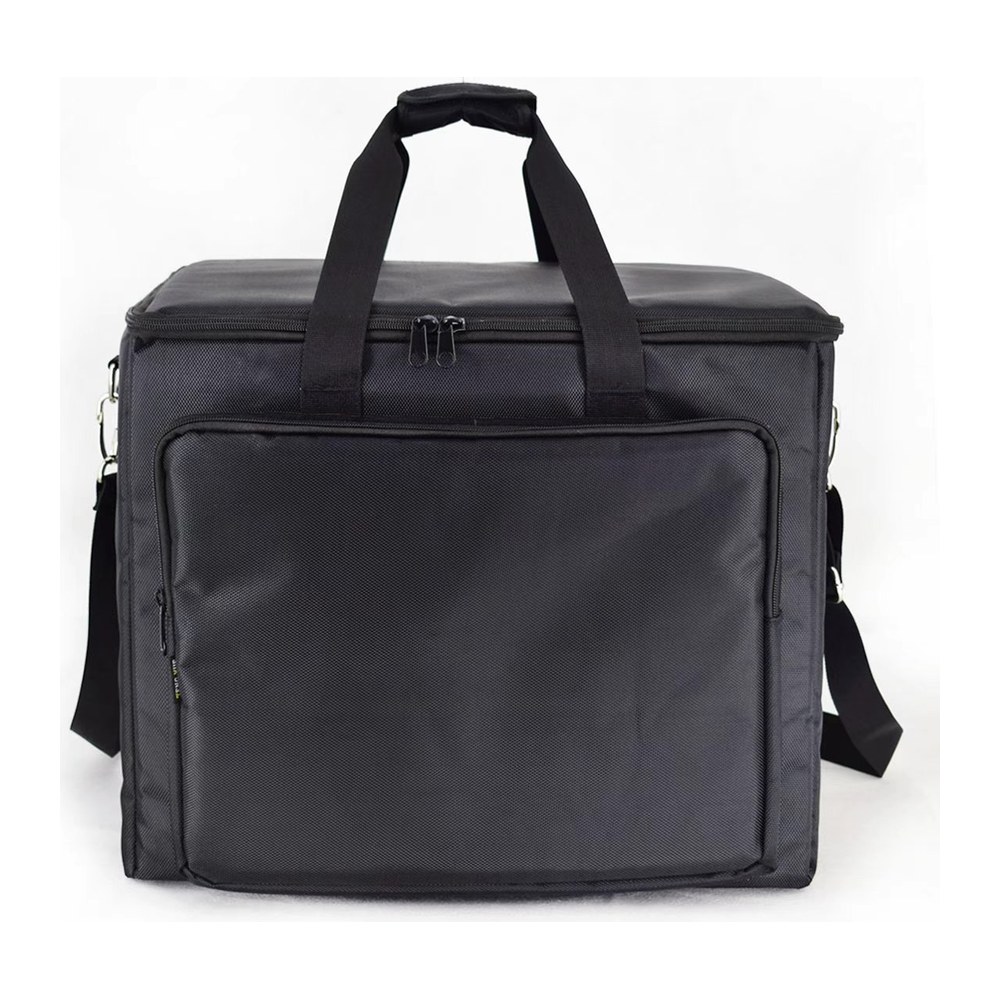
Padding compresses, fabric has thickness, and a zipper needs a path. Adding 1–2 cm in total to each dimension lets the equipment slide in and the zip close without force. Resist the urge to add more "just in case": an oversized bag is not a safer bag. Loose equipment shifts in transit and lands on a corner — the exact impact the padding was meant to absorb in a controlled way. If the equipment travels with an accessory permanently attached, measure it in that configuration. Our all-in-one computer carry bag is sized exactly this way: each size is cut around the unit's true outside dimensions, stand included, so the screen sits still instead of sliding.
4. Mark the fragile points
Dimensions give us the box; the fragile points give us the protection plan. Tell us which face carries the screen, which side carries the control panel, where the reel sits, which edge is a blade. That is where padding is concentrated and where seams are kept away. A photograph of the equipment from each side, with the fragile areas visible, is worth a paragraph of description. Buyers send us a photo, a physical sample, or dimensions — our in-house pattern team works from any of the three, and a photo plus dimensions is the combination that most often produces a first-sample fit.
5. What to send with your inquiry
Send the three dimensions, the protrusion notes, a few photos, the quantity you need and your logo file. The customization page walks through the options that follow — fabric grade, padding thickness, printing method. From your numbers we draft the pattern, and a physical sample follows in 5–7 days so you can test the fit on the real equipment before any production run. That sample check is the safety net: if a knob or a foot was missed, it shows up on the sample, not on five hundred finished bags.
The short checklist
- Three dimensions, each taken at its widest point
- Protrusions listed, with their position and size
- Fragile faces identified — screen, knobs, reel, blade edge
- Photos of the equipment from at least two sides
- Quantity, fabric and logo requirements noted
Questions buyers ask
How much extra room should I add to my measurements?
Add 1–2 cm in total per dimension. That covers the thickness of the fabric and padding and gives the zipper an easy path. More than that lets the equipment shift in transit, which removes the benefit of a made-to-measure bag.
Should I measure my old bag instead of the equipment?
No — measure the equipment itself. Old bags stretch and compress with use, so their dimensions describe the worn bag rather than the gear. If the old bag fits well, tell us that too; it is useful context, but the pattern is cut from the equipment numbers.
My equipment is an irregular shape. Can you still make a bag for it?
Yes. Irregular shapes are routine in custom work — amplifier heads, reels on rods, paddles with wide blades. Send the three main dimensions plus photos showing the shape, or send a sample unit, and the pattern team builds the shape from those.
What if I only have the manufacturer’s specification sheet?
Send the spec sheet — it works as a starting point, and we draft the first pattern from it. Keep in mind that spec sheets often list the body only and leave out knobs, feet and handles, so the sample check matters: test the sample on the real unit before approving production.