DJ Controller Bag Buying Guide: Fit, Padding and Gig-Ready Features
A DJ controller is a mixer, two decks and a sound card folded into one wide, flat unit — and it travels more than almost any other piece of music gear: house parties, weddings, club booths and corporate events, several times a week. The bag is what stands between that schedule and a bent crossfader, a cracked corner or a jog wheel knocked out of true. This guide covers how to spec a controller bag that fits your exact unit, protects the controls that matter, and carries the cables and laptop that travel with it.
1. Fit: controllers are sold by model, so bags should be too
Controllers come in model-specific footprints, and the differences hide in the details: a raised jog wheel here, a taller mixer section there, performance pads that sit proud of the surface. Measure the controller's length, width and height at its tallest control, and check that the bag's internal dimensions clear the jog wheels and faders with the lid closed. A universal bag sized "for most 2-channel controllers" leaves the unit sliding inside; a pattern cut to your model holds it still, and holding it still is what stops transit damage. Our guide on how to measure equipment for a custom bag shows the measuring routine in full.
If you run a rental fleet or a DJ school with several controller models, send us the model list. We cut one pattern per model, so every unit in the fleet travels in a bag that fits it, with the same fabric, pocket layout and branding across the whole set.
2. Padding where the controls live
The top face is the fragile face. Faders, knobs, pads and jog wheels all stand proud of the deck, and any pressure on a closed bag lands on them first. Look for foam across the full top panel, a soft lining that will not scuff the faceplate, and a fit snug enough that the controller cannot shift and rub. For gear that travels weekly, 10 mm foam is the working choice; our guide to bag padding thickness explains how thickness trades against weight and bulk. Corners deserve a second look: controller corners are hard plastic that cracks on a drop, and corner foam is cheap insurance.
| Universal-fit bag | Made-to-measure bag | |
|---|---|---|
| Fit | One size covers a band of models; the controller moves inside | Pattern cut to your controller's exact footprint and tallest controls |
| Control protection | Even padding, whether your model needs it there or not | Foam placed over the jog wheels, faders and mixer section |
| Kit storage | One main compartment; cables end up loose inside | Laptop sleeve and cable pockets specced around your gig kit |
| Branding | The supplier's logo, or none | Your logo: printing, embroidery or woven label |
3. Gig-ready features: cables, laptop and headphones
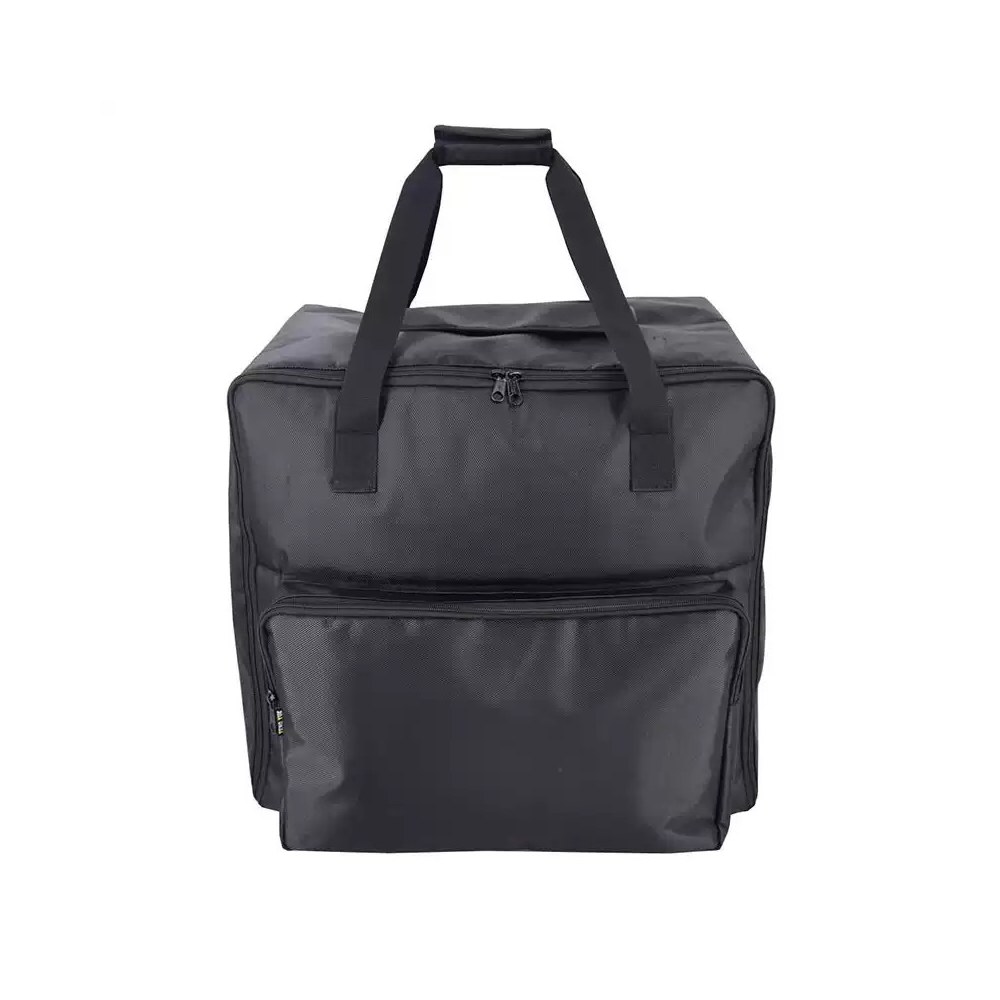
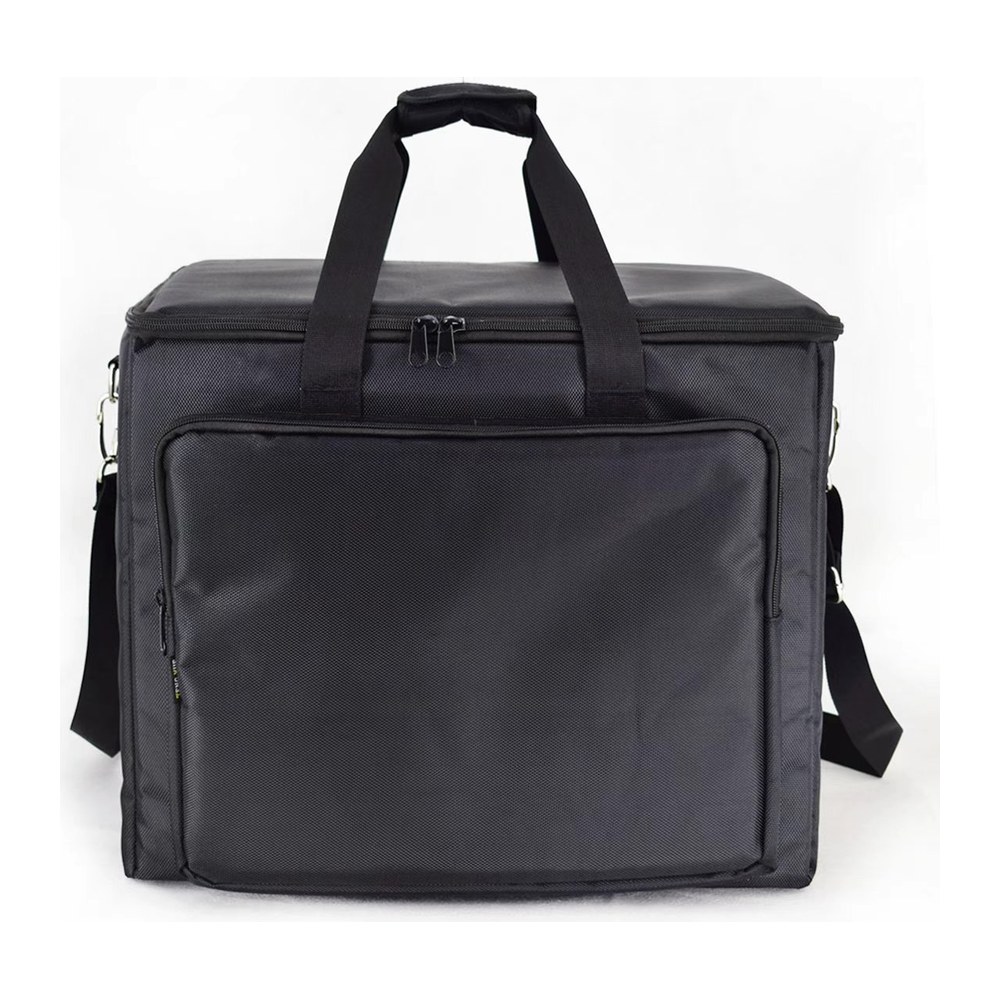
A controller never travels alone. The working kit is the controller, a laptop, a power supply, USB and audio cables, and headphones — and a gig-ready bag gives each piece its own place: a padded laptop sleeve or a separate laptop compartment, a cable pocket that keeps connectors away from the faceplate, and a pouch or strap for the headphones. Flat front pockets, like the one on our guitar amplifier bag, suit cables and small accessories well because nothing bulky presses against the main compartment. Check the zips too: two-way zippers let you open the bag from whichever end faces you in a cramped booth.
4. Carry: handles, shoulder strap and backpack options
Most controllers are carried by hand or on one shoulder, so a padded top handle and a detachable shoulder strap cover most gigs. Backpack straps make sense for DJs who travel by train or on foot with the full kit: they spread a heavy load across both shoulders and keep hands free for records, a stand or a door. Whichever system you choose, the handles should be webbing-anchored into the bag's seams — a loaded controller bag is heavy for its size, and the handle is exactly where cheap bags fail. A trolley sleeve on the back panel, which slides over the handle of a rolling case, is also worth adding for DJs who fly to gigs.
5. Fabric and custom branding
Working DJ gear earns 900D or 1680D Oxford fabric: booths, car boots and baggage areas rub bags hard, and the higher grades shrug it off, while a water-resistant backing handles rainy load-outs and spilled-drink venues. For DJ brands, rental companies and schools, the bag is also advertising — it is the most visible thing you carry into a venue. We print or embroider your logo, match fabric colours to your brand, and build mixed model runs in our small-batch workshop. Send us the controller model and quantity, and we will spec the bag.
The short checklist
- Internal dimensions checked against jog wheels and the tallest faders
- Foam across the full top face, with corner protection
- A separate place for the laptop, cables and headphones
- Two-way zippers; handles anchored into the seams with webbing
- 900D or 1680D Oxford fabric for weekly gigging
- Logo and colour matched to your brand or fleet
Questions buyers ask
Will a universal bag fit my controller?
A universal bag fits only if its internal dimensions clear your controller's jog wheels and tallest controls with room for the zip to close. Model-specific patterns are safer, because controllers with the same channel count still differ in depth and height.
How much padding does a DJ controller need?
10 mm foam is the working choice for a controller that travels weekly, covering the full top face where the faders and jog wheels sit. Lighter home and studio use can drop to 5 mm.
Can one bag carry the controller and a laptop?
Yes. We build controller bags with a padded laptop sleeve or a separate laptop compartment, plus cable pockets, so the full gig kit travels in one bag instead of two.
Can you put my DJ brand or rental company logo on the bags?
Yes — silk screen printing, heat transfer, embroidery and woven labels are all available, and we can run several controller models in one branded order with the same fabric and colours.
Tell us the controller model and how the kit travels, and we will spec the bag around it.